The Scrape That Wouldn't Heal
What if some of our biggest problems persist because we’re treating the wrong wound?
Let's start with something small. Before poverty, inequality, development goals, or politics, I want to talk about a scraped knee.
Two children come home after playing outside.
Both fell, and both scraped a knee. The first wound is ordinary. It stings, there’s a little blood, maybe a few tears. You clean it, dab on some antiseptic, and cover it with a plaster.
A few days later, the body has done what bodies are good at doing.
The second child had the same fall, the same scrape, the same care. But a few days later the wound is warm and swollen, and it hurts more than it did at the start.
So you change the plaster.
It doesn’t improve. You clean it again and put on a fresh plaster. It keeps getting worse, so you buy a better plaster, and still nothing changes.
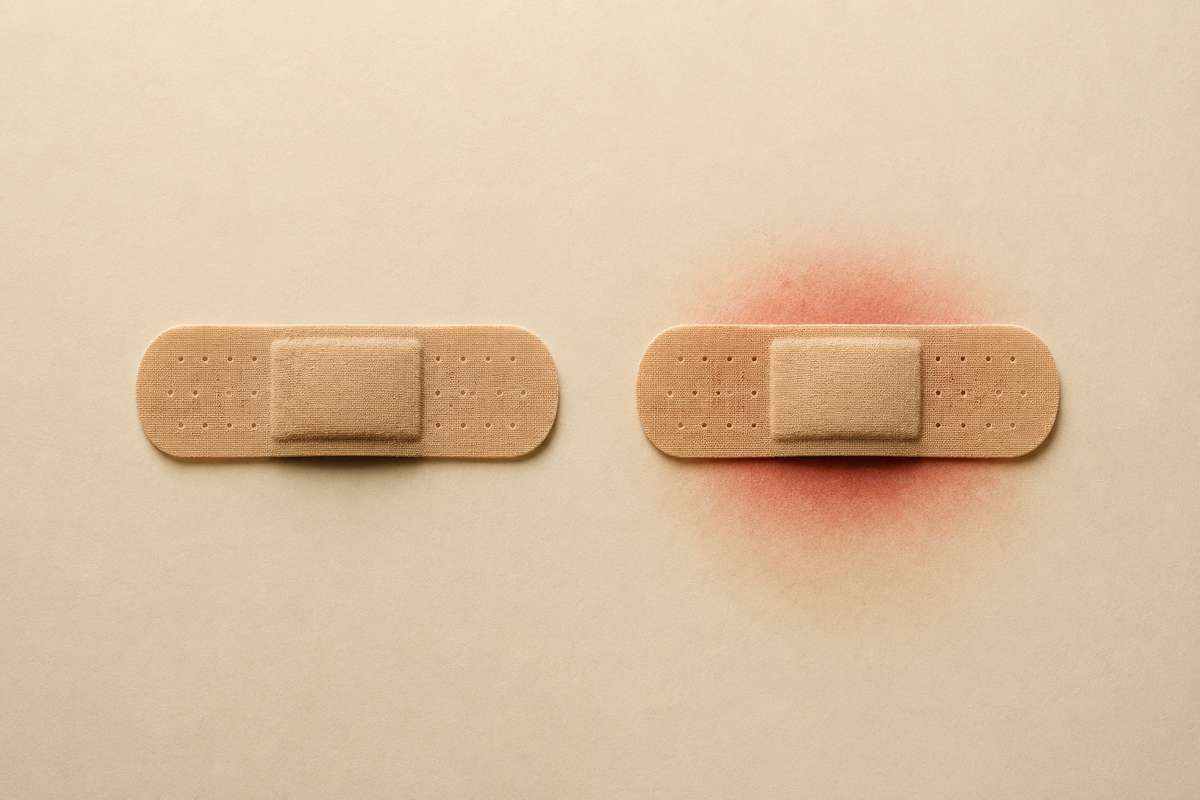
At some point, someone has to stop asking what’s wrong with the plaster and ask whether this is still a scrape. Maybe the wound is infected.
Once the diagnosis changes, the treatment has to change too.
The plaster was never a bad plaster. It was being asked to do a job it couldn’t do. I keep wondering how often we make the same mistake with much bigger wounds.
Look around the world and you won’t find a shortage of people trying to make things better.
Governments spend huge sums. Nonprofits build programs, researchers give their careers to hard problems, businesses invest, and communities organize. Between food assistance, housing assistance, scholarships, job training, healthcare, and tax credits, we have plenty of solutions.
Many of them do real good.
Someone eats tonight because food assistance exists. A family keeps its home because rental help arrived in time, and a student is at university because a scholarship came through.
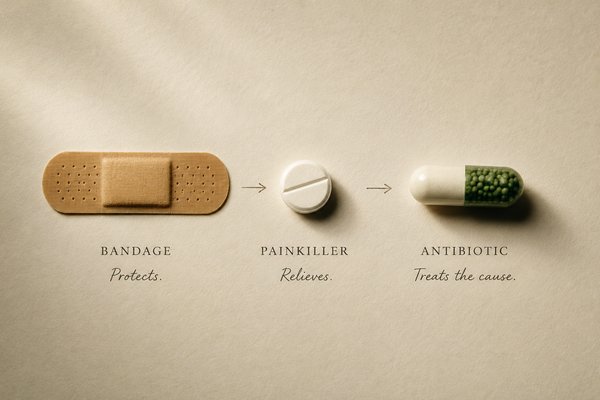
So the bandage isn’t the villain here. Sometimes a bandage is exactly what a wound needs. Even when it can’t cure what’s underneath, relief matters. If someone is in pain, easing it matters. If someone is hungry, feeding them matters.
The trouble starts when we mistake relief for a cure.
It also starts when we keep changing the bandage without checking whether the wound is still ordinary. A wrong diagnosis rarely leads to a ridiculous treatment, and that’s what makes it dangerous. It usually leads to a sensible treatment for the wrong condition.
History has a story I keep coming back to.
London, 1854. Cholera had killed thousands of people, and the leading theory blamed foul-smelling air, called miasma. If you believe bad air is the cause, aiming your efforts at the air makes complete sense. You’re following the diagnosis.
Then a physician named John Snow looked at an outbreak in Soho another way. He mapped where people were getting sick, and the cases clustered around something ordinary: a public water pump on Broad Street.
Snow suspected the water, and eventually the pump handle came off.
The popular version of this story is too tidy. Cholera didn’t leave London because one man removed one handle. What interests me is what happened before anyone touched the pump. The suspected source moved from the air to the water, and every sensible solution moved with it.
You could have spent a fortune fighting the smell. You could have hired London’s best experts to build the perfect smell-removal program. If the water was making people sick, all that work would still be aimed at the wrong layer of the problem.
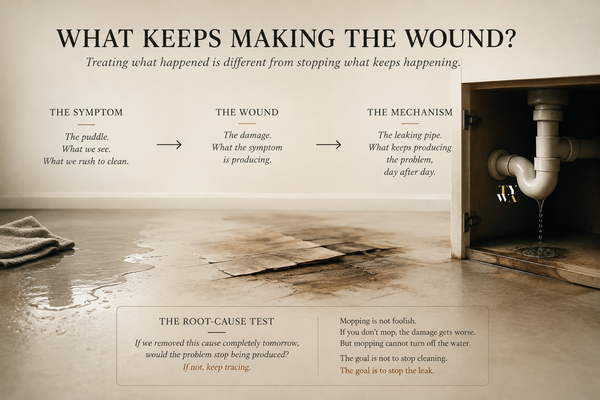
So before asking whether a solution works, ask what it’s treating.
That question is the reason this publication exists.
In 2000, world leaders adopted the Millennium Development Goals. There were eight of them, covering poverty, hunger, education, child mortality, maternal health, disease, sustainability, and global partnership. The deadline was 2015, and real progress followed.
Then came a new agenda.
The Sustainable Development Goals raised the count to seventeen, from no poverty to clean water to decent work to reduced inequality. The new deadline is 2030. Serious people set these goals and put serious money behind them.
Step back from any single program and look at the pattern. For decades we’ve named symptoms, set targets, and launched interventions. Many indicators have improved, yet many of the underlying problems are still here, looking much the same.
Could some of these wounds have been misdiagnosed?
If so, that wouldn’t prove the programs failed, or that the people running them failed. Maybe the programs needed more money. Maybe they were carried out poorly. Maybe wars and pandemics knocked them off course. Those explanations deserve a hearing, and so does misdiagnosis.
Say a program cuts hunger for a million people.
People ate, so that’s a success. So is a program that raises household incomes, or housing help that stops thousands of evictions.
A bandage can work and still not cure you.
The useful question is what kind of work it did. Did it protect someone in the moment and ease the pain? Did it repair damage already done? Or did it stop whatever keeps causing the wound? All of these count, which is why I don’t want “bandage” or “painkiller” to become insults in this Letter. Sometimes a bandage is what you need.
But if the wound is infected, someone eventually has to treat the infection. Otherwise we get very good at helping people live with a problem while whatever makes the problem keeps making it. That’s a strange kind of progress.
How do we tell which is which?
First, we slow down. Take poverty. The visible symptom might be low income, so raising income looks like the obvious treatment. Maybe it is. Before stopping there, ask one more question: what keeps producing low income?
That takes us one layer down. Employment, education, geography, capital, health, childcare, discrimination, and market structure could all play a part, maybe several at once. Then ask again what produces those conditions.
We may not find one neat root cause, because real systems are rarely that tidy. We might find several causes working together. We might find old damage whose source has already stopped, or a cause that’s still doing new harm today. Or we might find the first diagnosis was mostly right, which is a fine result too. The point is to diagnose before we prescribe, even when the diagnosis confirms what we thought.
I don’t have a catalogue of cures to open with, so we’ll start with something more basic: making sure we understand what we’re treating.
Here’s one question to take with you.
Pick a stubborn problem you care about. It could be housing costs, poverty, food insecurity, income inequality, education, or something much closer to home. Now think of the solution people most often propose for it, and imagine it works perfectly. Every dollar reaches the right place. Every eligible person signs up. Nobody blocks it and nobody mismanages it.
Would the thing causing the problem stop?
If yes, you may be getting close to the source. If no, you haven’t necessarily found a bad solution. You may have found a very good bandage, or a painkiller people badly need. But if the wound underneath is infected, we’ll need something else as well, and before we can prescribe it, we have to find the infection.
Until next time,
YA
We don’t just ask whether a solution works. We ask what it’s actually treating.