A Bandage Isn't a Bad Treatment
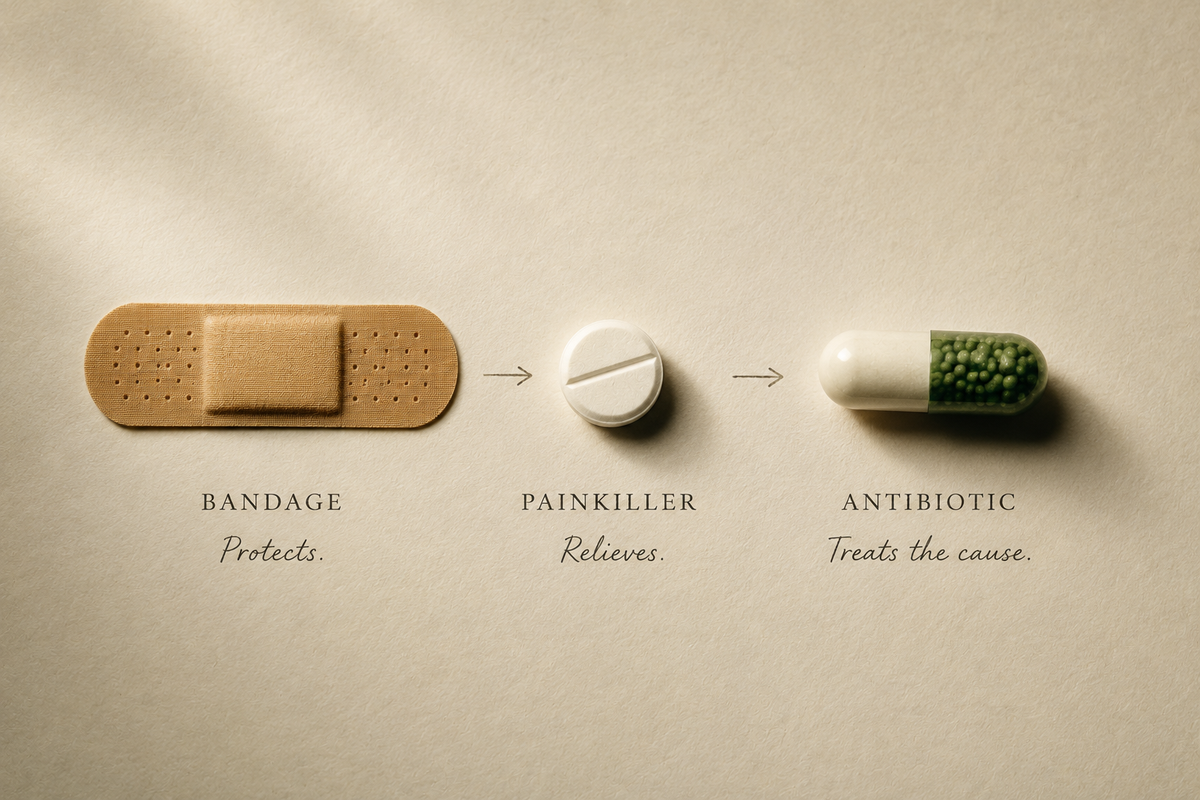
The mistake begins when we ask it to do the job of an antibiotic.
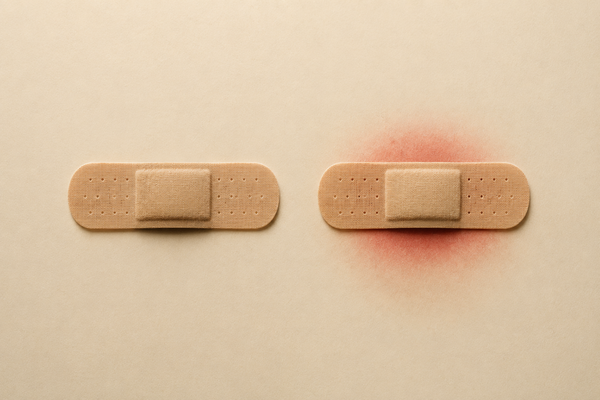
Last time we looked at two wounds that looked the same from the outside. One just needed time to heal. The other was infected. They got the same treatment and had different results, which left us with a question: if a solution worked perfectly, would the problem behind it actually stop?
This time, let's push that question further.
There’s a trap hiding inside the wound analogy. If we’re not careful, we start treating anything short of a cure as a bad solution. Sometimes you need the bandage. Sometimes you need the painkiller, sometimes the antibiotic, and sometimes all three. What matters most is knowing which one you’re holding.
Two things can be true at once
You walk into a doctor’s office in pain. They give you something for it, and twenty minutes later the pain eases.
Did the medicine work? Yes.
Now suppose the pain came from an infection. Did easing the pain clear the infection? No.
Both answers are true at the same time. The treatment worked, and the problem underneath is still there. With medicine that’s obvious. With society it gets surprisingly hard, because we keep asking whether a solution works. The better question is what it works on.
Three jobs
Each of these is a role. None of them is a grade.
🩹 The bandage stops the bleeding.
It protects and stabilizes, and it keeps things from getting worse right now. It doesn’t touch what caused the wound, and it doesn’t need to. If someone is bleeding, you stop the bleeding before anyone brings up root causes.
- Food for someone who needs to eat today
- Emergency shelter
- Stopping an eviction this week
- Keeping the lights on
💊 The painkiller eases the burden.
The problem stays, but living with it gets less brutal. That’s the job it was built for.
- A subsidy that eases the pressure
- A tax credit that leaves more in the bank
- A benefit that frees up money for other needs
If nobody touches whatever is producing the shortfall, people keep needing the painkiller. That might simply mean we’re grading a painkiller as if it were supposed to be a cure.
💉 The antibiotic goes after the mechanism.
This is the hard one. It asks what keeps producing the problem in the first place, then tries to disrupt the machine itself.
The machine usually lives in laws, markets, institutions, incentives, ownership, and habits that have lasted for generations. Machinery also tends to have people standing around it who depend on it running.
Try it on something real: housing
A city has too many working households that can’t afford rent. Wages didn’t keep up, and some families are one emergency away from eviction. The city rolls out rental assistance.
Which job is it doing?
Take your time with that. For the family facing eviction on Friday, it’s a bandage that stabilizes them right away. For another household, an ongoing subsidy works more like a painkiller, easing the burden and making the situation survivable.
Could it ever be an antibiotic? Maybe, if it changes whatever is actually making housing unaffordable. We haven’t shown that yet, and that’s the point: you can’t classify the treatment until you understand the wound.
One solution, several jobs
Real interventions don’t come pre-labeled. A scholarship can:
- Give immediate financial relief (bandage)
- Raise someone’s long-term earning potential (painkiller, maybe antibiotic)
- Open access to an institution that used to shut them out (antibiotic)
So the answer to “does this work?” is rarely one word. It looks more like a scorecard:
- Bandage: strong
- Pain relief: strong
- Source treatment: weak
- Long-term repair: possible
Sorting policies into clever boxes was never the goal. The scorecard shows you what’s still untreated.
The fourth job nobody talks about: recovery
Say the infection is gone and the source is under control. The wound still hasn’t healed. There’s damaged tissue, scarring, and weakness left behind. Stopping the damage and repairing it are two separate jobs.
This matters most with problems that have lasted for generations. Imagine a mechanism blocks one group from building wealth for fifty years. Then the rule changes, and starting today, access is equal on paper.
The homes that never got bought don’t suddenly appear, and neither do the businesses that never got built or the capital that never passed to the next generation.
Turning off the tap doesn’t dry the house. Since source control and recovery are different jobs, a full treatment plan might need all four working together: bandage, painkiller, antibiotic, and recovery.
Two ways to get this wrong
Mistake 1: Treating relief as a cure.
A program eases suffering, and we celebrate, as we should. Then we quietly assume the problem is solved. Years later the program is still needed at the same scale, because the mechanism producing the need never changed, so we call it a failure. Maybe it did exactly what it was built to do, and we assigned it the wrong job.
Mistake 2: Dismissing relief because it isn’t a cure.
“That doesn’t solve the root cause.” True. The person in front of you still needs to eat tonight. Root-cause thinking without immediate care is abstraction with good intentions. A serious solution has to do both.
Money tells you the dosage
A government announces a billion-dollar program, and the headline calls it a historic investment to tackle X.
The dollar figure tells you almost nothing about what’s being treated. A billion-dollar bandage is still a bandage. A small, precisely aimed program might do a completely different job. That doesn’t make the small one better by default. The price tag just isn’t a diagnosis.
The habit worth building
Before you decide whether you support a solution, whether it’s generous enough, or who deserves credit for it, ask what job it was designed to do:
- Immediate stabilization?
- Pain reduction?
- Source control?
- Recovery?
- Some combination?
Then ask whether that job matches the condition.
A brilliant antibiotic is wasted on a wound that isn’t infected, and the world’s best bandage can’t clear an infection that’s already there.
What we still haven’t answered
For two Letters we’ve talked about wounds and treatments without defining what makes a social wound infected. That was on purpose. “Infected” can’t simply mean that something is bad, that it has lasted a long time, or that I disagree with the people in charge. To call something infected, we need evidence that it’s still producing new damage today.
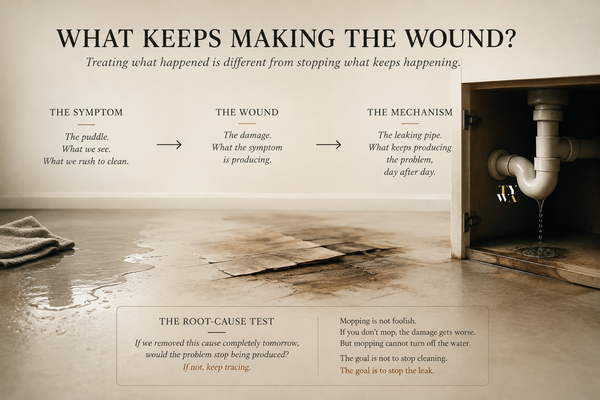
Picture a flooded house with soaked carpet, damaged walls, and ruined furniture. That tells you something happened. It doesn’t tell you whether the tap is still running, and we need to find that out before we clean anything up.
We don’t just ask whether a solution works. We ask what it’s actually treating.
Until next time,
YA